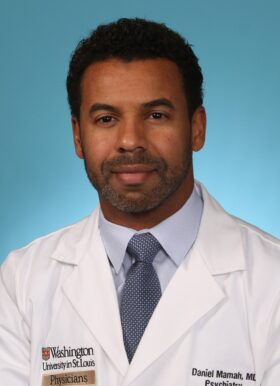
Additional Titles & Roles
- Director, Washington Early Recognition Center (2020-present)
Education & Training
- Postdoctoral Fellowship: Washington University, St. Louis, MO, 2007
- Residency: Washington University, St. Louis, MO, 2005
- M.D.: Semmelweis University, 1998
Major Awards
- Dean’s Impact Award, Washington University Medical School, 2025
- Dr. John M. Anderson Excellence in Mental Health Award, 2021
- BRAINS (Biobehavioral Research Award for Innovative New Scientists), NIMH, 2014
- DSM-5 Task Force, American Psychiatric Association: Member, 2006, 2007, 2008, 2009, 2010, 2011, 2012, 2013
- President (founding), Missouri Psychiatric Association, 2010, 2011
- Award for Outstanding Leadership, Eastern Missouri Psychiatric Society, 2010
- NARSAD Young Investigator Award, 2009
Areas of Clinical Interest
Daniel Mamah, MD’s clinical expertise focuses on the early identification and treatment of psychotic disorders, including schizophrenia and schizoaffective disorder. He is committed to advancing early intervention through a coordinated specialty care model, aimed at improving outcomes for adolescents and young adults experiencing early psychosis and those at clinical high risk. His research centers on the neurobiological mechanisms underlying psychosis, with a particular emphasis on the use of neuroimaging to identify biomarkers for early detection and treatment stratification. Dr. Mamah’s work aims to bridge the gap between cutting-edge neuroscience and practical clinical care, enhancing personalized treatment approaches for psychiatric disorders.
Research Interests
Dr. Mamah’s research combines advanced neuroimaging techniques and longitudinal studies to identify biomarkers that can predict the onset and progression of schizophrenia and other serious mental illnesses. He is particularly interested in understanding how structural and functional brain network changes relate to early psychosis, and how these changes can be leveraged for early diagnosis and personalized treatment. His work also explores the genetic and environmental factors contributing to psychiatric risk, aiming to improve both the early detection and treatment of individuals at risk for mental health disorders. In addition to his work in the U.S., Dr. Mamah has conducted epidemiologic, longitudinal, and neuroimaging studies in Kenya, where he has investigated the prevalence and progression of psychiatric disorders in African populations. Through his studies, Dr. Mamah seeks to enhance the precision and effectiveness of interventions for individuals experiencing early psychosis worldwide.
Recent Publications
-
An exploratory study of anxiety symptoms and associated factors among Kenyan youth recruited from colleges and communities in urban and peri-urban areas in the Nairobi Metropolitan
Ndetei, D. M., Mutiso, V., Musyimi, C., Jeremiah, E., Nyamai, P., Walusaka, S., Onyango, V., Mamah, D. & Bhui, K., Dec 2026, In: BMC Psychiatry. 26, 1, 726.
-
Functional network comparative area and topography analysis (FUNCATA) in non-affective psychosis: a replication study
Mamah, D., Chen, S. S., Harms, M. P., Curtis, M. & Dong, F., Dec 2026, In: npj Schizophrenia. 12, 1, 32.
-
Global and network-level topographic mapping of functional connectivity networks in schizophrenia and bipolar disorder using extended-duration resting-state fMRI
Mamah, D. & Chen, S. S., Oct 2026, In: Psychiatry Research – Neuroimaging. 362, 112288.
-
Dissociative experiences among Kenyan youth in the Nairobi metropolitan area: Associations with psychosis risk symptoms
Ndetei, D., Mutiso, V., Kioko, D., Walusaka, S., Malinda, S., Nyamai, P., Kiogora, Y., Onuonga, K., Achola, D., Thakya, D., Jeremiah, E., Onyango, V., Musyimi, C. & Mamah, D., Jun 25 2026, In: Global Mental Health. 13, e158.
-
Vertexwise Cortical Deviation Mapping (VCDM): A precision approach to cortical thickness assessment in non-affective psychosis
Mamah, D., Chen, S. S., Dong, F., Harms, M. P., Curtis, M. & Anokhin, A., Apr 2026, In: Brain Imaging and Behavior. 20, 2, 24.